How-To
How to Make Hypochlorous Acid at Home
A step-by-step guide to how to make hypochlorous acid at home with a countertop generator, salt, water and vinegar, then check ppm and pH.
hypochlorous.com is funded and produced by HOCL LLC, which sells the Eco One and other machines that make HOCl, including the products linked in this post. HOCL LLC does not sell bottled HOCl. Who funds this site
How to store HOCl after you make it: closed, protected from light, at room temperature or cooler, in HDPE, LDPE or PET, and why heat, air and low pH shorten shelf life.
HOCl storage and shelf life depend on how you handle the solution after the generator stops. Freshly made hypochlorous acid is a chlorine solution whose concentration and pH can change in the container. HOCL LLC’s storage practice is to keep finished HOCl closed, protected from light, at room temperature or cooler, in HDPE, LDPE or PET. Heat and exposure to air degrade HOCl. pH belongs in the same conversation: the making target is pH 5–6, and a finished pH of 4–5 means a very short shelf life.
This article is about storage conditions, the Eco One manual’s storage statement, and re-testing.
When a run on a unit such as the Eco One is finished, test ppm and pH first (see PPM and pH Basics), then move the solution out of the open pitcher and into its storage container. Leaving a batch sitting open increases air contact. Empty and rinse the pitcher after you pour it out, and dry the connector so the next run starts clean.
Do not store HOCl in a container you cannot close, in a clear bottle left in a window, or next to a heat source (stove, vehicle cabin, direct sun). Those conditions work against the “closed, light-protected, room temperature or cooler” rule.
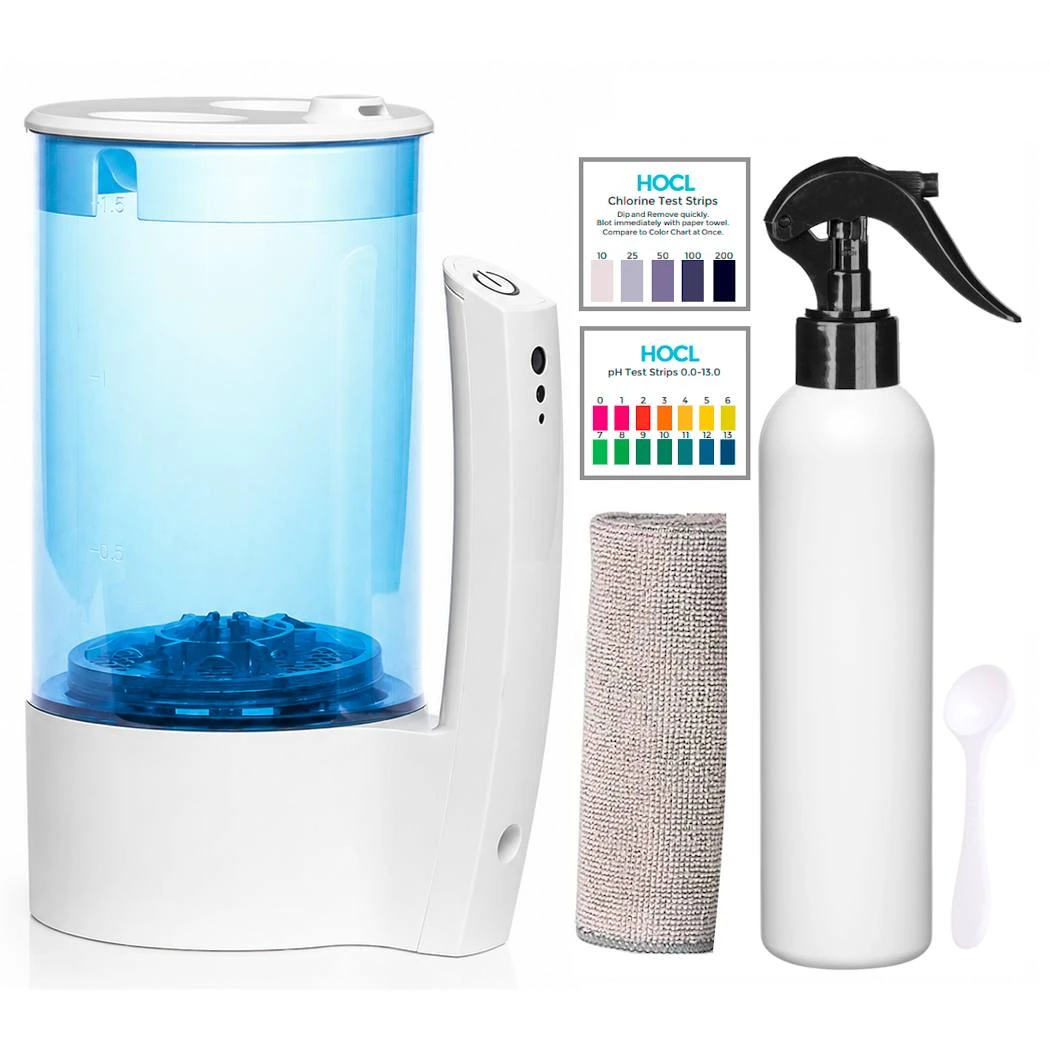
Use a chlorine-compatible plastic. HOCL LLC’s list is HDPE, LDPE or PET. The fine-mist bottle that ships with the Eco One is PET, which fits that list for day-to-day spraying, provided you cap it. For a larger stored volume, use a closable, opaque HDPE jug.
Avoid metal containers, containers of unknown plastic, and anything that previously held a different chemical and cannot be fully cleaned. Do not put HOCl in a container that cannot be sealed.
If you also make the Eco One’s potassium hydroxide cleaner, store that solution in its own clearly labeled container. Do not combine it with HOCl.
Three ordinary conditions shorten the useful life of a batch:
None of those points requires a laboratory to apply. Cap the jug, keep it cool and out of the light, and do not decant more air into the headspace than you need to.
Make batches to pH 5–6, which is the target in HOCL LLC’s Eco One and Hypo 7.5 directions. Storage does not reset a bad pH.
HOCL LLC does not suggest buffer formulations, and this guide does not offer one. Do not add other chemicals to a finished batch.
The Eco One manual states: “Manufacturer-stated storage: keeps close to 90% of its strength for about 90 days in a closed, light-protected container at room temperature or cooler.” That is a storage statement for that machine’s solution under those conditions—not a guarantee for every batch or for other machines. Re-test before you rely on an older container.
If concentration has dropped below what you need, or pH has moved out of range, make a fresh liter. How to Make Hypochlorous Acid at Home covers a new Eco One run; the machine is sold at store.hocl.com/ecoone, with test paper and a bundle available.
Each time you open a jug you add air, and each pour changes the headspace. Recap promptly. If you decant into the Eco One’s PET fine-mist sprayer, treat that sprayer as a working bottle: cap it, keep it out of sun and heat, and do not use it as the only long-term store for a large batch. Leave the bulk in the closed HDPE jug and refill the sprayer as needed.
If you stored a batch that finished at pH 4–5, plan a short hold and re-test sooner. A batch below pH 4 should not have been stored at all; make a new liter and correct the vinegar step.
The Eco One makes a 1 L recipe in a 1.5 L pitcher (fill to the 1 L line). When you need a fresh liter, How to Make Hypochlorous Acid at Home covers the 200 ppm and 500 ppm runs, including 1 teaspoon or 2 teaspoons of 5% distilled vinegar and the papers you use to check the result.
Shelf life is not a substitute for a paper reading. A well-stored jug can still drift; a poorly stored jug will drift faster. The generator makes the batch; storage and testing are how you know what is still in the jug.
Keep reading
A step-by-step guide to how to make hypochlorous acid at home with a countertop generator, salt, water and vinegar, then check ppm and pH.
How to read HOCl ppm and pH, why the target is pH 5–6, and how to use a 1:5 dilution on high-range test paper, as printed in the Eco One manual.