How-To
How to Make Hypochlorous Acid at Home
A step-by-step guide to how to make hypochlorous acid at home with a countertop generator, salt, water and vinegar, then check ppm and pH.
hypochlorous.com is funded and produced by HOCL LLC, which sells the Eco One and other machines that make HOCl, including the products linked in this post. HOCL LLC does not sell bottled HOCl. Who funds this site
How to read HOCl ppm and pH, why the target is pH 5–6, and how to use a 1:5 dilution on high-range test paper, as printed in the Eco One manual.
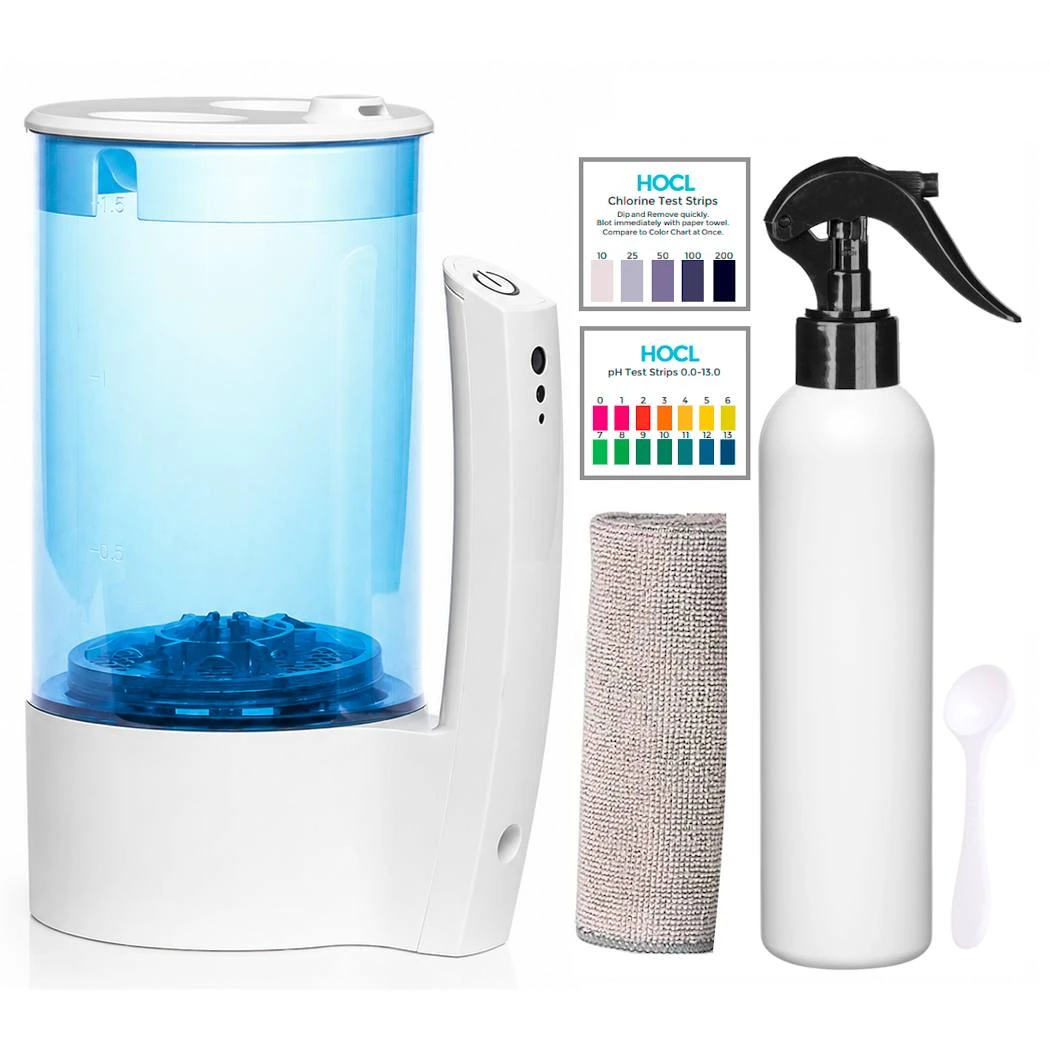
PPM and pH are the two readings that tell you what a freshly made HOCl batch actually is. An HOCl generator runs for a set time, but the timer is not the measurement. Concentration is read in parts per million (ppm) with chlorine paper; acidity is read as pH with separate pH paper. HOCL LLC’s target for batches from its Eco One and Hypo 7.5 directions is pH 5–6. This article explains how to take both readings, including the Eco One manual’s 1:5 dilution method when the batch is above the paper’s printed range.
In this context, ppm is the free chlorine concentration of the solution, as read by your chlorine test paper. The paper that ships with the Eco One, and the replacement roll at store.hocl.com/testpaper, is a 10–200 ppm chlorine paper. That range covers the Eco One’s 40, 60, 100 and 200 ppm programs when the batch is near those targets. It does not, by itself, display 500 ppm.
Read the paper exactly as its package directs (dip time, wait time and color chart). Use a fresh strip for each reading and don’t “average” two colors into a number the chart doesn’t show.
PPM is not pH. A correct 200 ppm reading at the wrong pH is not the same batch as 200 ppm at pH 5–6.
pH is the acidity of the solution. Hypochlorous acid sits in equilibrium with other chlorine species; which form predominates depends on pH. HOCL LLC’s directions for the Eco One and the Hypo 7.5 aim at pH 5–6, using 5% distilled vinegar as the adjustment.
Practical bounds, from HOCL LLC’s guidance:
Measure pH on the undiluted batch with pH paper, not with chlorine paper and not on the diluted sample you may mix for a high-range ppm check.
If pH is above the target after a run, do not guess at a large extra vinegar addition. Note the reading, review the vinegar amount the manual specifies for that mode, and run a new batch with the correct starting dose rather than repeatedly acidifying a finished pitcher.
For an Eco One 200 ppm liter (2 g kosher salt, 1 tsp of 5% distilled vinegar, Setting 3 run twice for 16 minutes) or for the 40 / 60 / 100 ppm settings:
If the chlorine paper reads far below the program (or does not change), check salt dose, run time, paper expiry and water hardness (under 80 ppm is recommended for the Eco One). If pH is outside 5–6, check the vinegar step before you change anything else.
The Eco One manual specifies 5% distilled vinegar for both recipes: 1 teaspoon for 200 ppm and 2 teaspoons for 500 ppm (added before the 40-minute run). pH paper confirms the result.
When a batch is intended to be above 200 ppm—for example the Eco One’s 500 ppm, 40-minute program—the 10–200 ppm paper is off-scale if you dip it in the full-strength solution. The Eco One manual’s method is:
Dilute 1 part HOCl with 4 parts water (a 1:5 dilution), read the paper on that mixture, and multiply the reading by 5.
Worked example:
Other readings follow the same multiplier: 10 ppm on the dilution corresponds to 50 ppm in the original, 50 ppm to 250 ppm, and 200 ppm to 1,000 ppm. If the diluted reading is still above 200 ppm, the original is above 1,000 ppm and this paper cannot finish the measurement—do not invent a second dilution factor here.
Use clean, measured volumes (for example 10 mL of HOCl plus 40 mL of water) so the 1:5 ratio is real. Use distilled water for the dilution so the water itself adds nothing to the reading. Do not test pH on this diluted cup; pH stays a separate, undiluted measurement.
This 1:5 method is printed in the Eco One manual. It is a way to read concentration. It is not a use direction for the diluted cup, and it is not a reason to skip pH.
Keep chlorine paper and pH paper dry, in their packaging, and within any date on the pack. Replacement HOCl test paper (10–200 ppm) is on the store. The Eco One ships with both chlorine and pH paper; a bundle is available if you are buying the machine with a sprayer.
After storage, pH and ppm can move. Heat and air exposure degrade HOCl, and a batch that finished at pH 4–5 already has a very short shelf life. Re-test after storage and before you rely on an old jug. See HOCl Storage and Shelf Life.
If you are still setting up a machine, How to Make Hypochlorous Acid at Home puts these tests at the end of a 200 or 500 ppm Eco One run. For a larger batch unit, use the test method in that model’s manual and the same pH 5–6 target where that manual gives it.
Keep reading
A step-by-step guide to how to make hypochlorous acid at home with a countertop generator, salt, water and vinegar, then check ppm and pH.
How to store HOCl after you make it: closed, protected from light, at room temperature or cooler, in HDPE, LDPE or PET, and why heat, air and low pH shorten shelf life.
How an HOCl generator, or hypochlorous acid machine, turns water, salt and a small amount of vinegar into a measured HOCl batch you can test for ppm and pH.