How-To
How to Make Hypochlorous Acid at Home
A step-by-step guide to how to make hypochlorous acid at home with a countertop generator, salt, water and vinegar, then check ppm and pH.
hypochlorous.com is funded and produced by HOCL LLC, which sells the Eco One and other machines that make HOCl, including the products linked in this post. HOCL LLC does not sell bottled HOCl. Who funds this site
How an HOCl generator, or hypochlorous acid machine, turns water, salt and a small amount of vinegar into a measured HOCl batch you can test for ppm and pH.
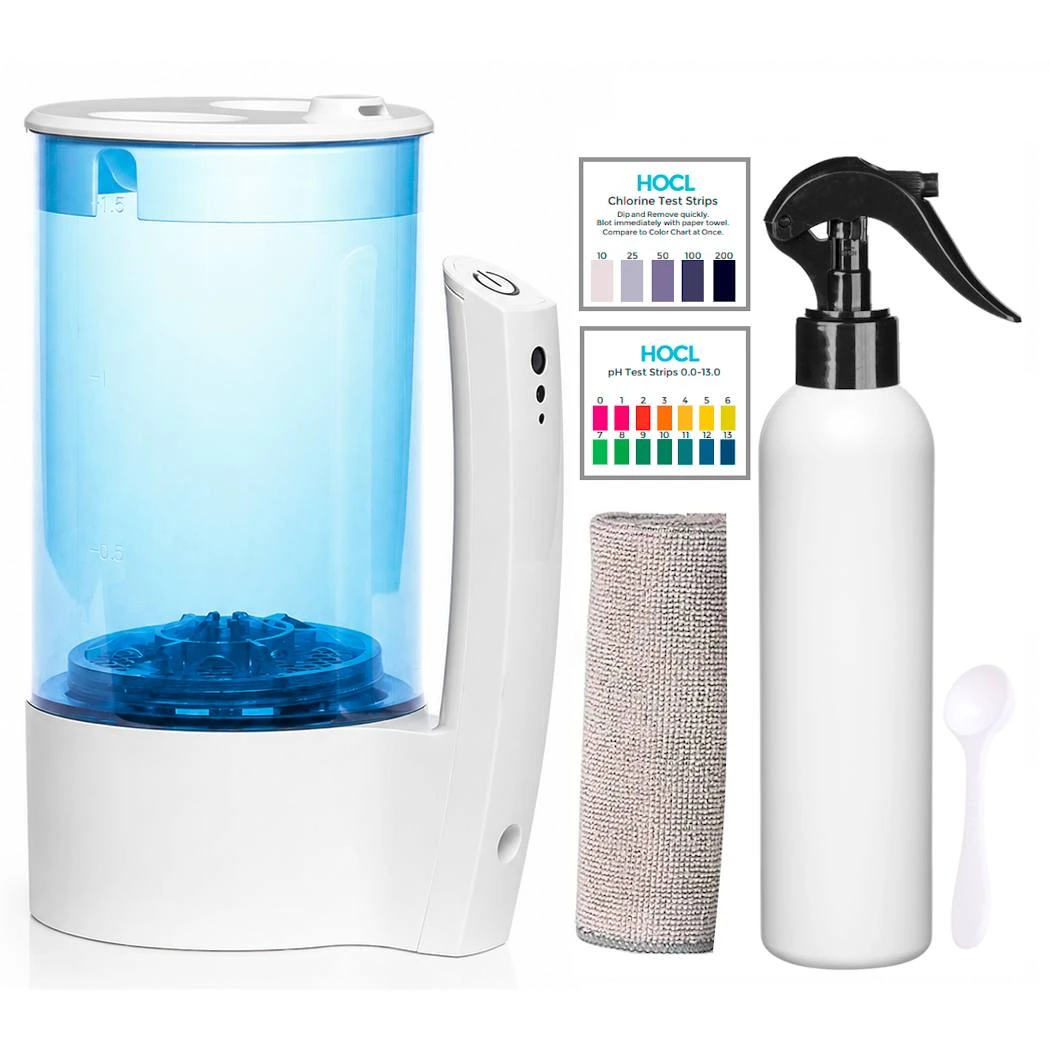
An HOCl generator—also called a hypochlorous acid machine—is an electrolysis device that makes hypochlorous acid (HOCl) from water, salt and, when directed, a small amount of vinegar. Instead of buying a bottle, you run a measured batch in a machine built for this purpose, then check concentration (ppm) and pH. This article explains what happens in the cell, why pH matters, and how a home unit such as the Eco One is set up to do that work.
The core of an HOCl generator is an electrolysis cell. Food-grade salt (sodium chloride) dissolved in the water supplies chloride. When the power unit drives current through the cell, part of that chloride is converted to free chlorine, which in water is present as hypochlorous acid (HOCl) and hypochlorite ion (OCl⁻). The Eco One manual calls the result electrolyzed water; the molecule this guide is about is HOCl.
That chemistry is pH-dependent. HOCl is the undissociated acid form. As pH rises, more of the same chlorine is present as hypochlorite ion (OCl⁻) instead. As pH falls too far, chlorine gas can leave the solution. A 2008 CDC guideline (p. 41) describes this pH-dependent balance between HOCl and OCl⁻. HOCL LLC’s target for batches from its manuals is pH 5–6. Distilled vinegar is the acid adjustment those directions use to land in that window—not a substitute for testing.
A hypochlorous acid machine does not “add HOCl” from a cartridge. It generates the species in place from the salt you add, the water you start with, the run time you select and the pH of the finished solution.
Home and small-facility generators come in two broad layouts:
The working principle—electrolysis of a chloride solution, then pH control and testing—is the same idea. The difference is volume, installation and how you time a run. If you are choosing among models, see Choosing an HOCl Generator.
On a pitcher unit such as the Eco One, a typical 200 ppm liter looks like this:
The lid is part of the Eco One directions. Empty and rinse the pitcher after use, keep it out of the dishwasher, and dry the connector before the next run. The unit uses its supplied detachable power unit.
None of those times is a substitute for a paper reading. A generator’s program is a starting method; ppm and pH confirm what you actually made.
People sometimes treat ppm as the only number that matters. In this chemistry, pH decides which chlorine species you have at that ppm.
That is why a hypochlorous acid machine is paired with two tests, not one. PPM and pH Basics walks through the papers and the 1:5 dilution. HOCl Storage and Shelf Life covers what to do after the run.
The Eco One can run a second, separate process: a potassium hydroxide (KOH) cleaner, made from food-grade potassium carbonate instead of salt. Among HOCL LLC’s current machines, only the Eco One makes that cleaner. Do not mix salt and potassium carbonate in one pitcher; the two products are not a single solution. Label the KOH cleaner clearly. The KOH cleaner is strongly alkaline. Wear gloves, keep it away from children, and never mix it with HOCl, bleach or other cleaning products.
An HOCl generator is not a bottle of pre-made solution, and HOCL LLC does not sell bottled HOCl. The machine is also not a “set and forget” appliance: the Hypo 7.5 manual, for example, calls for daily leak and wire checks and monthly scale checks, and HOCL LLC does not describe that model as maintenance-free. This guide does not state a guaranteed electrode or cell life for any model; see each model’s manual and warranty.
If you want a home-scale hypochlorous acid machine for 1-liter batches, the Eco One is the unit this site walks through in How to Make Hypochlorous Acid at Home. Keep test paper on hand so each run is checked, not assumed.
Keep reading
A step-by-step guide to how to make hypochlorous acid at home with a countertop generator, salt, water and vinegar, then check ppm and pH.
How to read HOCl ppm and pH, why the target is pH 5–6, and how to use a 1:5 dilution on high-range test paper, as printed in the Eco One manual.
A specifications comparison of two HOCl generators, the Eco One and the Hypo 7.5, so you can match batch size and features to what you need.