How-To
How to Make Hypochlorous Acid at Home
A step-by-step guide to how to make hypochlorous acid at home with a countertop generator, salt, water and vinegar, then check ppm and pH.
hypochlorous.com is funded and produced by HOCL LLC, which sells both machines compared on this page and the products linked in it. HOCL LLC does not sell bottled HOCl. Who funds this site
A specifications comparison of two HOCl generators, the Eco One and the Hypo 7.5, so you can match batch size and features to what you need.
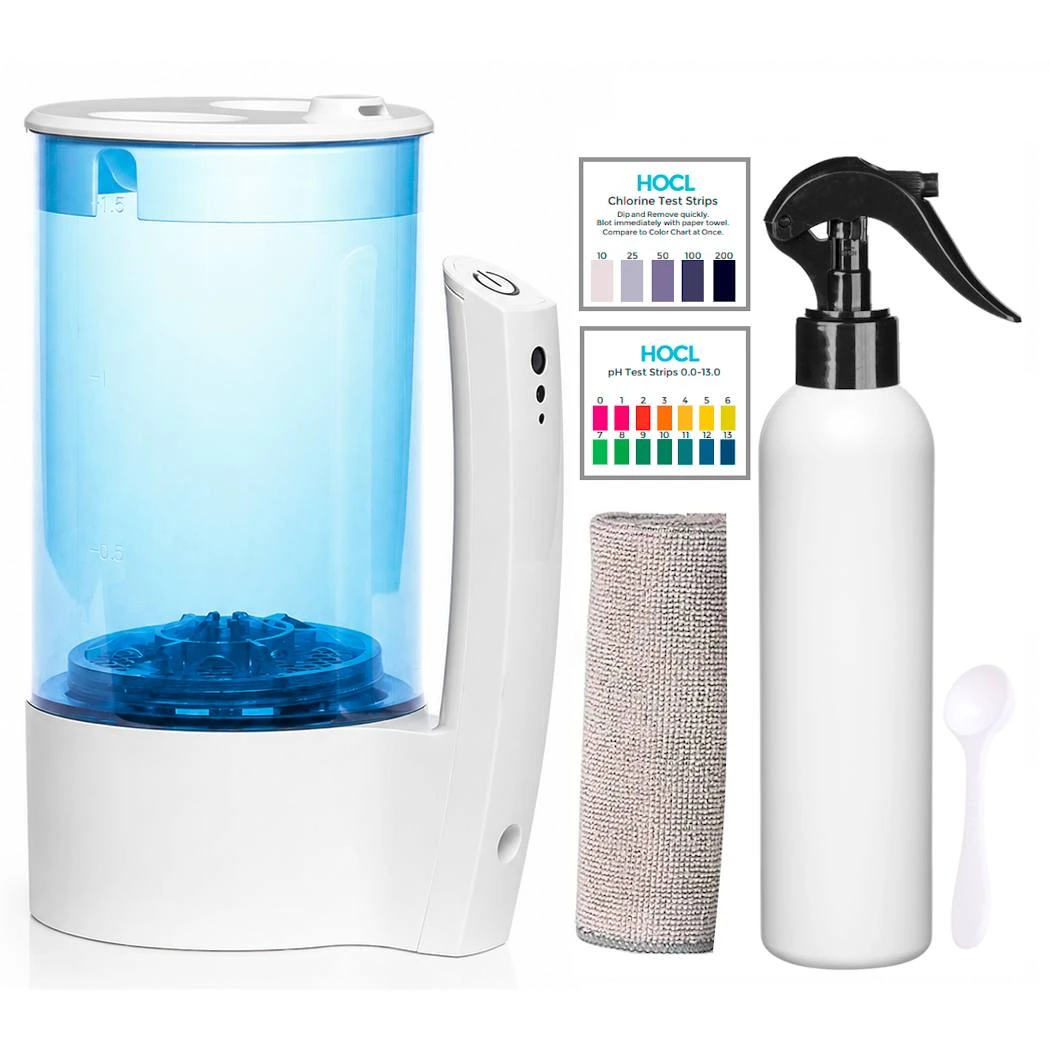
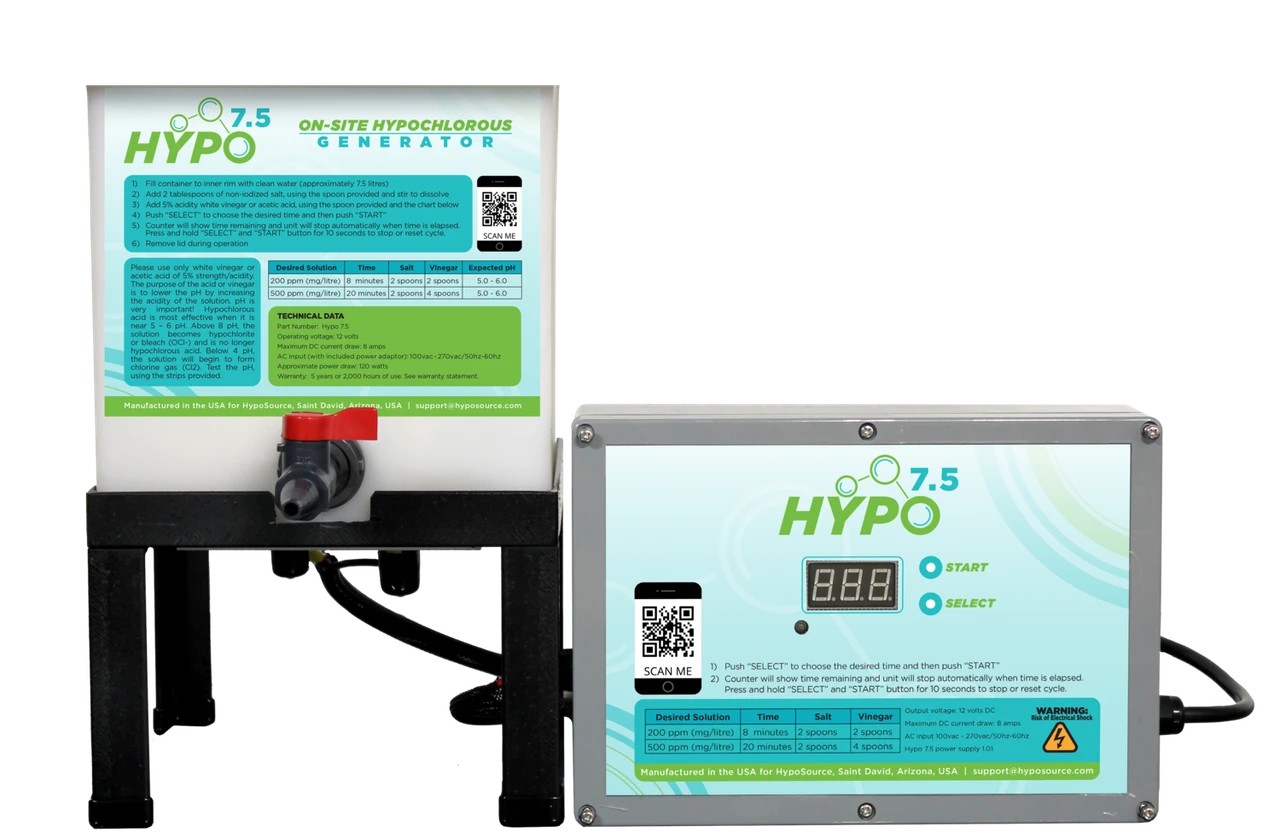
Choosing an HOCl generator is mostly a question of volume and which extra functions you need. This page compares two machines sold by HOCL LLC—the Eco One and the Hypo 7.5—using specifications from each model’s current manual.
If you want a simple home batch with included test paper, start with the Eco One. Step up in volume only when 1 L runs are not enough. HOCL LLC also sells plumbed, continuous-flow units for facilities; those are outside the scope of this home guide.
Figures below are from each model’s current manual. They are generation and installation specifications, not use claims.
| Eco One | Hypo 7.5 | |
|---|---|---|
| Layout | 1 L batch in a 1.5 L pitcher (fill to the 1 L line) | 7.5 L (2 gal) batch |
| Listed HOCl programs | Setting 1: 40 ppm / 3 min; Setting 2: 60 ppm / 5 min; Setting 3: 100 ppm / 8 min, or run twice (16 min) for 200 ppm; 500 ppm / 40 min, all at the 1 L line | 200 ppm / 8 min or 500 ppm / 20 min; pH 5–6 |
| Salt / acid (HOCl) | 2 g kosher salt per 1 L (food-grade, non-iodized recommended). 200 ppm: 1 tsp of 5% distilled vinegar, pH 5–6. 500 ppm: 2 tsp of 5% distilled vinegar before the 40-min run, pH 5–6 | Salt and 5% vinegar amounts per the current Hypo 7.5 manual |
| Water | Hardness under 80 ppm recommended | See the Hypo 7.5 manual |
| Installation / power | Supplied detachable power unit; lid is part of the directions | Electrical requirements per the Hypo 7.5 manual |
| Electrode / cell life | Not specified in the manual | 4,000 operating hours is a technical estimate, not warranty coverage |
| Testing | Chlorine paper 10–200 ppm; pH measured separately | High-range chlorine strips before use; pH strips separately |
| Care / checks | Empty and rinse after use; no dishwasher; dry the connector | Daily leak and wire checks; monthly scale checks; not maintenance-free; no lid supplied |
| Other function | Only this model makes the potassium hydroxide cleaner (potassium carbonate in place of salt) | — |
| Country of manufacture | South Korea | United States |
| Solution storage duration | See the storage guide | Not stated in the Hypo 7.5 manual |
The Hypo 7.5 warranty is issued by HypoSource LLC (hyposource.com), not HOCL LLC; its electrode technical life of 4,000 hours is not an extension of warranty coverage. For the Eco One, read the current warranty text on the Eco One product page rather than a summary on this page.
The Eco One is built around a 1 L recipe. Fill only to the 1 L line molded on the pitcher (about mid-height), not to the top of the 1.5 L pitcher. For a 200 ppm liter, add 2 g of food-grade, non-iodized kosher salt and 1 teaspoon of 5% distilled vinegar, then run Setting 3 twice (16 minutes) and confirm ppm and pH with the papers that ship in the box. For 500 ppm, use the same 2 g of salt and 2 teaspoons of 5% distilled vinegar before the 40-minute run. The lid is part of the Eco One directions. After the run, empty and rinse the pitcher, and dry the connector. Among these two machines, only the Eco One also makes a potassium hydroxide cleaner, from food-grade potassium carbonate in place of salt—not mixed with it.
The Hypo 7.5 is a larger batch: 7.5 L, which the manual also calls 2 gallons, in a commercial design, with programs listed at 200 ppm in 8 minutes or 500 ppm in 20 minutes and a pH target of 5–6. It ships without a lid. Use the salt and 5% vinegar amounts in the current Hypo 7.5 manual rather than copying the Eco One teaspoon recipe into a 7.5 L tank. The manual calls for daily leak and wire checks and monthly scale checks; it is not a maintenance-free unit. High-range chlorine strips and separate pH strips are the testing method in that manual. The 4,000 operating-hour electrode figure is a technical estimate, not warranty coverage, and the warranty is issued by HypoSource LLC, not HOCL LLC.
Both machines make HOCl from water, salt and vinegar, then rely on you to test the result. Neither run time is a substitute for a paper reading. If a number you need is not in the table, use that model’s current manual.
Keep HOCl test paper and pH paper on hand for either machine. For Eco One batches above the 10–200 ppm paper’s range, the Eco One manual’s method is a 1:5 dilution (1 part HOCl plus 4 parts water, then multiply the reading by 5). See PPM and pH Basics. Storage conditions—closed, protected from light, at room temperature or cooler, in HDPE, LDPE or PET—are in HOCl Storage and Shelf Life. For a dated look at salt, vinegar and machine price versus bottled listings, see Hypochlorous Acid by the Gallon.
Both are hypochlorous acid machines in the sense described in How an HOCl Generator Works. Neither replaces testing. Keep HOCl test paper and pH paper on hand regardless of model.
For most people making their first batches at home, the Eco One is the direct fit. See the Eco One product page or the HOCl bundle to get started, then use How to Make Hypochlorous Acid at Home for the run itself.
Keep reading
A step-by-step guide to how to make hypochlorous acid at home with a countertop generator, salt, water and vinegar, then check ppm and pH.
How an HOCl generator, or hypochlorous acid machine, turns water, salt and a small amount of vinegar into a measured HOCl batch you can test for ppm and pH.
Hypochlorous acid by the gallon: dated Nov 10, 2026 bottled prices per liter, and the cost of making a liter with the Eco One—salt, vinegar and machine price—with the math shown.