How-To
How an HOCl Generator (Hypochlorous Acid Machine) Works
How an HOCl generator, or hypochlorous acid machine, turns water, salt and a small amount of vinegar into a measured HOCl batch you can test for ppm and pH.
hypochlorous.com is funded and produced by HOCL LLC, which sells the Eco One and other machines that make HOCl, including the products linked in this post. HOCL LLC does not sell bottled HOCl. Who funds this site
A step-by-step guide to how to make hypochlorous acid at home with a countertop generator, salt, water and vinegar, then check ppm and pH.
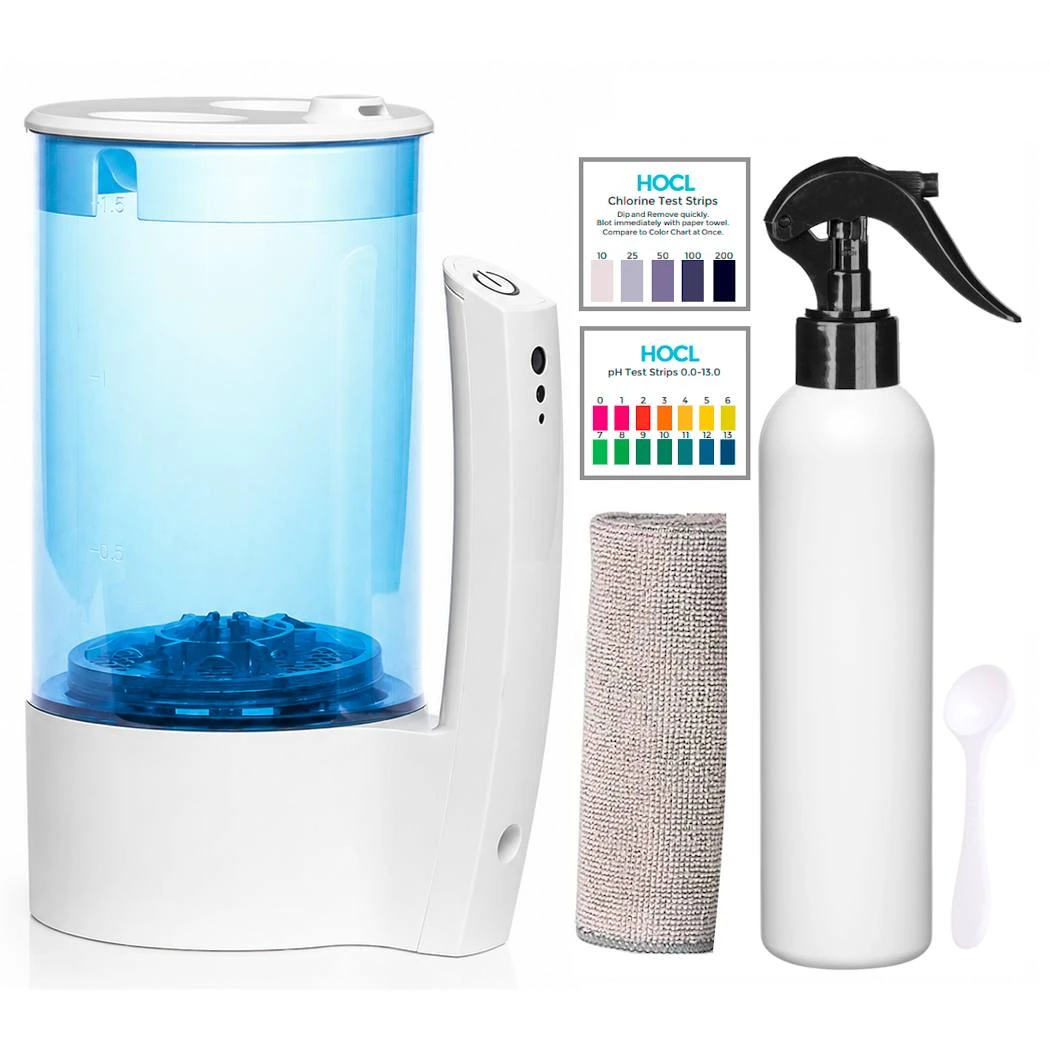
If you want to know how to make hypochlorous acid at home, you do not need a laboratory. A purpose-built HOCl generator, a measured amount of food-grade salt, ordinary water and a small amount of distilled vinegar are enough to run a 1-liter batch. This guide follows the current Eco One manual: what to put in the pitcher, how long to run it, how to check concentration and pH, and how to store what you make. HOCL LLC sells machines only; it does not sell bottled HOCl.
Do not improvise a generator from unmarked electrodes or household current. This guide covers a machine built for this use, used as its instructions describe.
Empty and rinse the pitcher after any previous run, and dry the power connector before you plug the unit in. The Eco One uses a supplied detachable power unit; do not put the pitcher in a dishwasher. The lid is part of the Eco One directions—use it as the manual shows.
Fill the pitcher to the 1 L line molded on the pitcher (about mid-height), not to the top. The pitcher holds 1.5 L; the recipe is for 1 L. Results vary with water quality, which is why the manual recommends hardness under 80 ppm. If your supply is harder than that, use a lower-hardness source rather than guessing at a homemade treatment.
For a standard 200 ppm liter on the Eco One:
At the 1 L line, Setting 3 (8 minutes) generates 100 ppm, Setting 2 (5 minutes) 60 ppm and Setting 1 (3 minutes) 40 ppm. The manual notes that ppm figures are approximations that vary with water quality, so verify with test paper rather than assuming the run time guarantees a number.
For a 500 ppm liter, use the same 2 g of salt, add 2 teaspoons of 5% distilled vinegar to the pitcher before the 40-minute run, and keep pH at 5–6. Treat the result as a prepared solution to be tested—not as an authorization for any particular use.
Because the included chlorine paper reads 10–200 ppm, a 500 ppm batch is above the printed scale. The Eco One manual’s method for readings above the strip’s 200 ppm limit is a 1:5 dilution: 1 part HOCl plus 4 parts water, then multiply the reading by 5. A 100 ppm reading on the diluted sample corresponds to 500 ppm in the original batch. Measure pH on the undiluted solution, with pH paper, not with the chlorine paper.
Making hypochlorous acid at home is not finished when the timer stops. Adding vinegar lowers pH so that hypochlorous acid (HOCl) is the dominant free chlorine molecule; pH is what keeps a batch in the intended window.
For a fuller explanation of readings, dilution math and pH, see PPM and pH Basics.
Never mix. Do not try to make HOCl by mixing bleach with any acid or acid-containing product. That can release chlorine gas. Do not mix HOCl or bleach with ammonia; that can release chloramine gas. Do not mix HOCl, bleach or the KOH cleaner with each other or with other cleaning products. The KOH cleaner is strongly alkaline. Wear gloves and keep it away from children.
If someone is exposed, call Poison Help at 1-800-222-1222; call 911 for an emergency.
The Eco One can also make a potassium hydroxide (KOH) cleaner. That run uses food-grade potassium carbonate in place of salt—not in addition to it. The Eco One manual’s cleaner directions are: add 2 grams of potassium carbonate and run Setting 3 to generate KOH in 8 minutes, using only the potassium carbonate additive. Do not combine salt and potassium carbonate in the same batch; the two processes are separate. Among HOCL LLC’s current machines, only the Eco One makes this cleaner. Keep KOH solution clearly labeled and apart from HOCl. The KOH cleaner is strongly alkaline. Wear gloves, keep it away from children, and never mix it with HOCl, bleach or other cleaning products.
Pour finished HOCl into a closed container that is protected from light, and keep it at room temperature or cooler. Use a chlorine-compatible plastic such as HDPE, LDPE or PET. Heat and exposure to air degrade HOCl, so do not leave the pitcher open on the counter longer than you need to test and transfer it. Details are in HOCl Storage and Shelf Life.
This is a how-to for making and checking a batch with a labeled home machine. It is not a use chart, not a comparison of every generator on the market, and not a claim about bottled products. If you are choosing a machine, start with the Eco One for 1-liter home batches, or see Choosing an HOCl Generator for a specifications comparison with a larger batch unit.
To make your first liter, use the Eco One with the included papers, or add test paper if you already have a machine and need a fresh roll.
Keep reading
How an HOCl generator, or hypochlorous acid machine, turns water, salt and a small amount of vinegar into a measured HOCl batch you can test for ppm and pH.
How to read HOCl ppm and pH, why the target is pH 5–6, and how to use a 1:5 dilution on high-range test paper, as printed in the Eco One manual.
How to store HOCl after you make it: closed, protected from light, at room temperature or cooler, in HDPE, LDPE or PET, and why heat, air and low pH shorten shelf life.